Monday, 11 May 2015

Character Reviews

https://s-media-cache-ak0.pinimg.com/originals/0c/0b/02/0c0b027d32edb529ed0b170de17fcbcd.jpg

Estella

Estella plays Miss Havisham’s beautiful, young protegee, and revenge tool. Estella, is Pip’s unattainable dream throughout the production. He loves her passionately, but, though she sometimes seems to consider him a friend, she is usually cold, cruel, and uninterested in him. As they grow up together, she repeatedly warns him that she has no heart. Estella has a well- mannered, superior yet mysterious like essence to her character. She is portrayed to be a typical English rose; pale complexion, rosy cheeks and lips, beautiful hair etc, and is desired by all men. 


Pip

http://images6.fanpop.com/image/photos/32200000/Pip-great-expectations-2012-32221860-1000-1500.jpg
Phillip Pirrip nicknamed Pip, an orphan and the protagonist and narrator of Great Expectations. In his childhood, Pip dreamed of becoming a blacksmith like his kind brother-in-law, Joe Gargery. At Satis House however he meets Estella, a contact which destroys his peace of mind. He tells Biddy that he wants to become a gentleman. As a result of Magwitch's anonymous patronage, Pip travels to London and becomes a gentleman. Pip assumes his benefactor is Miss Havisham, and discovering that his true benefactor is a convict shocks him.
Pip is portrayed as a passionate, romantic, determined, young man, who is set on improving himself both morally and socially. 

http://images6.fanpop.com/image/photos/32200000/Miss-Havisham-HQ-great-expectations-2012-32221800-3046-5000.jpg
Miss Havisham

Miss Havisham wealthy spinster who takes Pip on as a companion for her adopted daughter, Estella. Embittered after being jilted at the altar by her fiance some years before, Havisham is an eccentric woman who perpetually wears her wedding dress. She conceives a hatred for all men, and plots to wreak a twisted revenge by teaching Estella to torment and spurn all men, including Pip, who loves her. Miss Havisham is later overcome with remorse for ruining both Estella's and Pip's chances for happiness. Shortly after confessing her plotting to Pip, she dies as the result of being badly burned when her dress accidentally catches fire.

Victorian women in television

Ripper Street (BBC TV SERIES 2013)


http://cdn.images.express.co.uk/img/dynamic/1/590x/ripper-street-407919.jpg
Ripper Street is a BBC TV Series, set in the late Victorian era; 1889, in Whitechapel. During the aftermath of Jack The Ripper murders. The infamous H Division, the police precinct is charged with keeping order in the district of White chapel- which is in a chaotic state after a tumultuous time for London and reported infamously worldwide.The streets of London's East End are awash with blood. But this is not the 19th Century; this is not Jack the Ripper - this is a copycat killer and once again the police remain clueless.

This Show is very male orientated, but the few women who are featured within this drama, i feel, reflect the late Victorian style in a very authentic way, with the exception of some aspects. The lead female; Long Susan 'Miss Susan', played by MyAnna Buring, has the classic hairstyle of the hair being piled on the top of the head with Marcel waves on the surface. The Parting at the front of the head, which is on the side, goes against the norm of normally having a middle centered parting. This could be because of her signature hate which she wears ff to the side, so they altered the style slightly. The makeup is very natural; as it was in that era, wit only a small amount of nude eye shadow and red/ purple shade on her lips.    


 http://programm.ard.de/sendungsbilder/teaser_huge/008/POCUTF8_7305997325_Original_Daccord.JPEG

Oliver Twist (FILM 2005) 

Based on another of Charles Dickens Novels, set in the late 1830's. It is the story of an Orphan boy, Oliver Twist, is sent to a workhouse, where the children are barely fed and mistreated. He moves to the house of an undertaker, but after an unfair severe spank, he starts a seven day runaway to London. He arrives exhausted and starving, and is welcomed by a gang of pickpockets leaded by the old crook Fagin. When he is mistakenly taken as a thief, the wealthy victim Mr. Brownlow brings Oliver to his home and shelters him. But Fagin and the dangerous Bill Sykes decide to kidnap Oliver to burglarize Mr. Brownlow's fancy house. Oliver is wounded, while Mr. Brownlow tries to save Oliver. 

The Lead Female Character; Nancy, is the lover of Bill sykes. She lives in poverty, and even though it is not outrightly said, it is highly suggested that she is a prostitute and thief. With this in mind, Women who wore makeup in that era  were widely thought of as prostitute, and the majority of them actually were. This would make perfect sense as her character, does have alot more visible makeup on then other women of a higher status in that era. She has rouge lips and cheeks, quite a pale skin tone, which are cleverly applied in a way that looks as if it is self applied by a non- experienced hand. The Hairstyle of nancy is stylised to fit in with the era; middle parting, ringlets covering the ears and the rest of the hair gathered back into a bun/ chignon.   


The Gothic

The term 'Gothic' usually refers to a genre of Literature which encompasses both Romance and horror, making it alluring to the audience. This movement in literature is thought to have been initiated by Horace Walpole with his publication of the novel 'The castle of Otranto'. Other Authors prominent within the early 19th century can also be involved in this Genres popularity; Anna Radcliffe, Edgar Allen Poe, Bram Stoker are only a few.
The Gothic is also widely associated with Architecture, Buildings such as Salisbury Cathedral, which exude eccentricity and is very elaborate. Were often mentioned in Gothic Novels.

Great expectations features a strong Element of Gothic within the novel as a whole, and also within each characters individual story and journey within the book. A few examples of this is, of course, the doomed, romance between pip and Estella, being forged on an ulterior motive, gives it a high Gothic quality. It is also present at the beginning of the novel with Miss Havisham; being Jilted at the Alter by her fiancee who, as it just so happens, also has ulterior intentions.


Miss Havisham Developement

For My Miss Havisham Design, I want to portray her character as she was post- wedding. So I want to develop my Makeup and Hair look with this in mind. The reason For this, is because as i was watching Great Expectations (2012) and researching the Miss Havisham portrayals, i was drawn to these styles the most.I find them very interesting and had a strong urge to recreate them myself! The aspects and details involved to create these looks; pale, chalky skin, ageing, etc. Are appealing to me and i am eager to see how my creation compares to the ones used in TV and Film.

Looking at all the interesting and different ways and styles different designers have interpreted Dickens' Eccentric charaater, from what i've seen, shows just how diverse the outcome could be. I particularly like the versions shown in the Video below. The use of Ageing Makeup is particularly relevant to me as this was one of the first aspects i wanted to include within my design,

I also am leaning toward the idea of having makeup running/ smudged on the face; the lips and eyes. The makeup that wore on her wedding day would not have been cleaned off and most likely been smudged and her face would look dirty with the residue left on it.

I will make the hair grey from either applying powder or Dry shampoo, this will also help to give the appearance of a dusty texture as well.

Victorian Hairstyles

The Victorian Era Was during the period of Queen Victoria's Reign during 1837-1901. It was a period of peace, refined sensibilities and conservation. The women were not as extravagant or outrageous with their appearance as they might have been in the past, instead, they aimed for a natural, feminine, neat and reserved appearance. I will be looking into the hairstyles worn throughout this period.

1930-1940

Continuing on from the previous decade; the Top knot was still Fashioned amongst most women, However it became higher, and less wide. It was consisted of flat loops,a dn bows of the hair and sometimes intertwined with braids, pearls flowers, feathers and other decorative items. The hair continued to still be brushed and combed flat and sleek to the head, and with a center parting. THe decorative curls were fashioned to the sides of the face and usually covered the ears; and generally ended up being more prominent than the topknot itself. 
Towards the middle of the decade the topknot and curls became looser. The Topknot shrank, and moved to the back of the head. The tight ringlets at the side of the head loosened, turning into long spirals. Or alternatively they would be plaited, and sometimes they disapeared altogether. The hair still remained sleek and flat to the head however.  

1831 (Richard Corson- Fashions in Hair page 513)
1834 (Richard Corson- Fashions in Hair Page 513)
G- 1838, K- 1839
(Richard Corson- Fashion in Hair page 517)

1940 (Richard Corson- Fashions in Hair Page 517)

 1940-1950

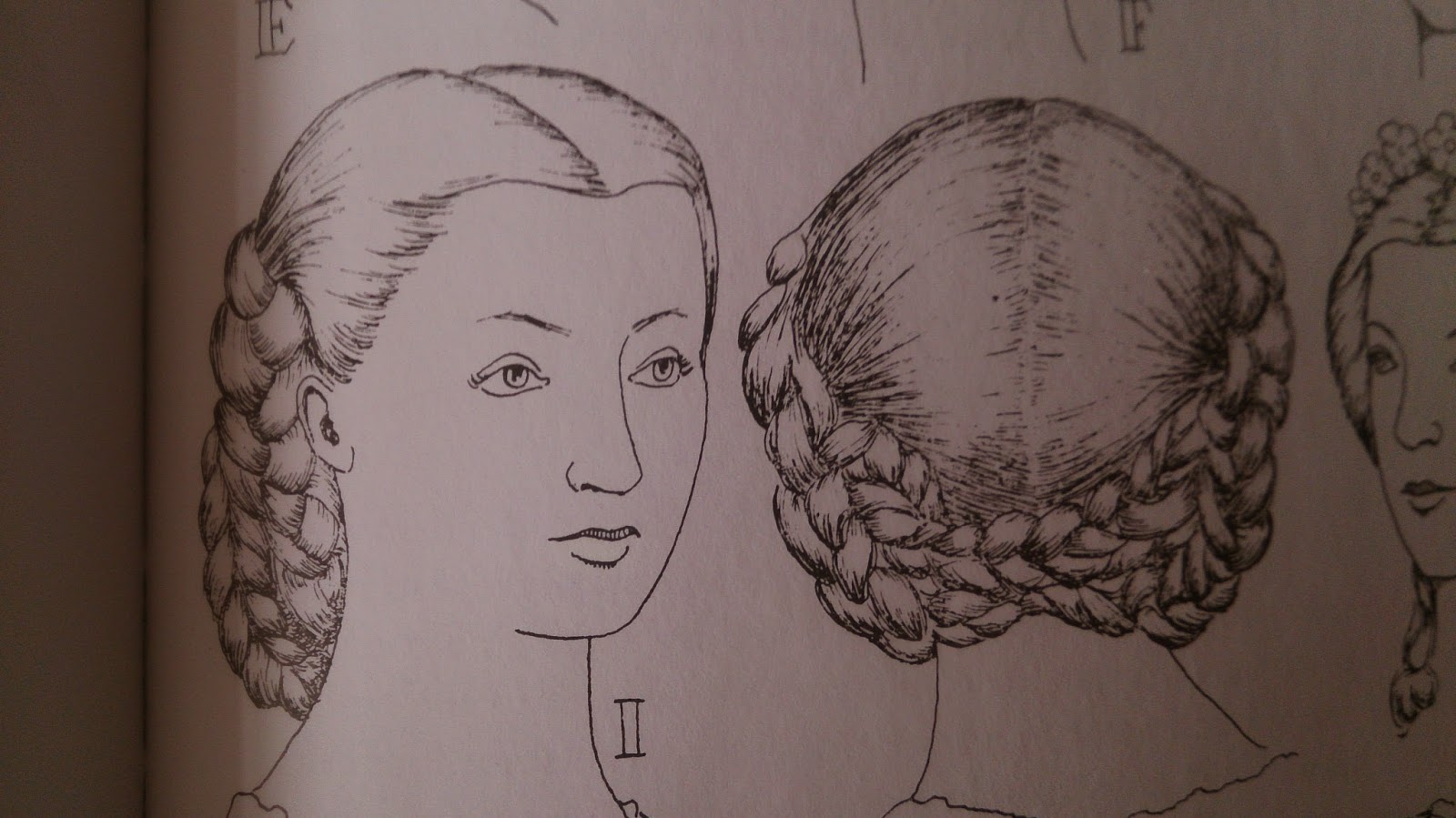
The hairstyles in this Decade more or less stayed the same as the previous decade, with only a few modifications. The hair was still flat and sleek against the head, and the same partings as before, Occasionally the bun was higher than the crown but more often than not, it was lower. The side hair was still just as important, occasionally consisting of one or more spiral Curls, but big looping plait, exposing the ears, became alot more common.
Later on in the decade the plaits, at the side of the head gradually began to be coiled in front of the ear. Braids were used extensively at the back of the head, or over the top.
As the Decade went by the use of side curls and brides were used less and less, with the exception of evening wear. The bands of the hair were simply brought down and over the ear, then carried to the back. The trend of using decorative accessories like feathers, grapes, lace, flowers etc. carried on, especially in the evening.
1841 (Richard Corson- Fashions in Hair Page 519)

1842 (Richard Corson- Fashions in Hair Page 519)
1844 (Richard Corson- Fashions in hair Page 519)
1847 (Richard Corson- Fashions in Hair Page 521)
1849 (Richard Corson- Fashions in Hair Page 521)

 1850-1860

 The Hair in this Era was styled Simply, and the trend of longer hair was starting to become exceedingly popular, and carried on as such for a long period of time. The hair was still middle parted and styled so that nearly all of the hair is used at the front of the head. The hair is puffed and then smoothed over the sides of the face, covering the ears.
1851-1854 (Richard Corson Fashions in Hair, Page 523)

1854-1857 (Richard Corson Fashions in Hair, Page 527) 

1858-1859 (Richard Corson Fashions in Hair, Page 527)

1860-1870

The Hair was still parted down the middle of the head, and the hair at the sides of the head still covered the ears. The back portion of the hair, however, was generally fashioned into a twisted plait, or looped plaits. The hair was frequently decorated with ornaments like feathers, pearls, flowers, ribbons etc.
As the decade progressed, the wearing of twisted plaits, progressed into just low rolls by the nape of the neck, often more than one roll was worn. Plaits were sometimes worn to decorate the rolls. The rolls secured with decorative combs.
Towards the middle of the decade, The sides of the hair began to be pulled back slightly so the ears were shown, but the middle parting was still visible.
By the end of the decade, middle parting were beginningt o slowly fade, being replaced by short curls, an the rolls at the back of the head, were becoming higher. They also began to have loose decorative ringlets flowing from them.
1860 (Richard Corson- Fashions in Hair, Page 229)
1961 (Richard Corson- Fashions in Hair, Page 231)

1863 (Richard Corson- Fashions in Hair, Page 231)


1865 (Richard Corson- Fashions in Hair, Page 233)

1866 (Richard Corson- Fahions in Hair Page 235)

1869 (Richard Corson- Fashions in Hair, Page 237)

1870-1880

 During this Decade Chignons, and Coiffures were in full effect, and by far the most common style. The hair is completely off from the sides of the face, and are puffed and pulled back at the temples, styled into waves to soften the look. A few curls were then fashioned just above the brow. The back of the hair is worn straight back, and fastened and confined into a net. Those with alot of hair still wore it in thick plaits, turned up and fastened at the top of the head, then decorated with robbons and Bows. No curls were worn but only 'frizzles' over the forehead.
Towards the middle of the decade, Chignons were becoming less and less popular, being replaced by with the hair being piled ontop of the head, mostly being compiled of fake hair, which was styled with curled and twisted. This carried on throughout the Century.
1870 (Richard Corson- Fashions in Hair, Page 239)

1873 (Richard Corson- Fashions in Hair, Page 241)

1876 (Richard Corson- Fashions in Hair, Page 243)

1877 (Richard Corson- Fashions in Hair, Page 245)

1879 (Richard Corson- Fashions in Hair, Page 245)

1880-1890

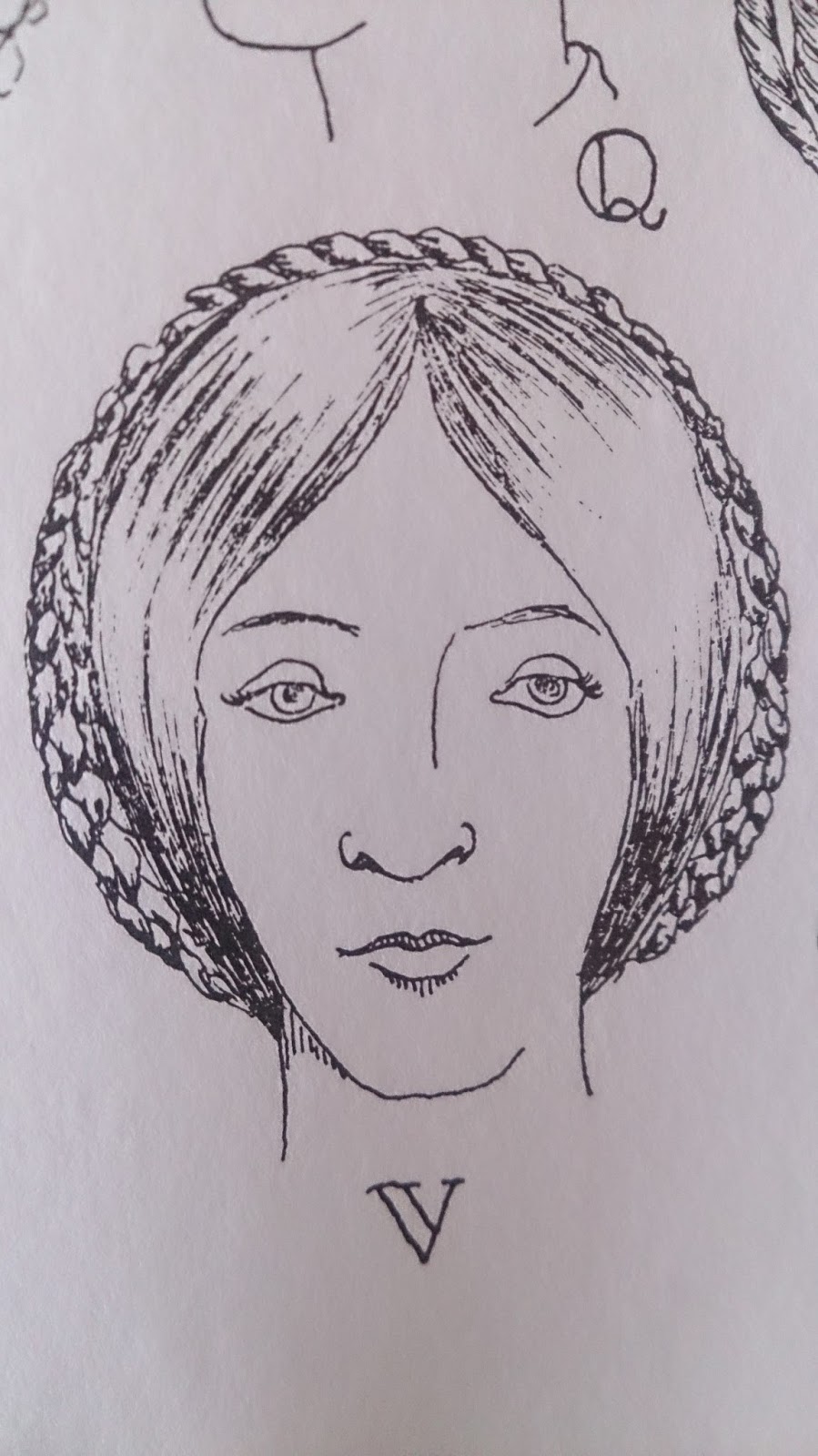
Masses of hair continued to be worn throughout the 80's, occasionally drooping low on the neck but more often concentrated on the top and the back of th head, being held in place with large pins or decorative combs. the hair was softer around the face than what it previously had been. The side hair was usually gently waved, and during the early part of the decade a fringe across the forehead was fashionable. A slightly fluffy effect was the result. Frequently the front hair was false, as well as the torsades, puffs, rolls and curls. 
Towards the end of the century the Marcel wave was becoming extremely popular, and the hair styled similarly in knots, twists, rolls and plaits at the back of the head. With a few short curls added wherever seemed suitable. 

1881 (Richard Corson- Fashions in Hair, Page 247)


1883 (Richard Corson- Fashions in hair, Page 247)

1885 (Richard Corson- Fashions in Hair, Page 249)
1886 (Richard Corson- Fashions in Hair, Page 251)


P- 1889 Q+ L- 1888 (Richard Corson Fashions in Hair, Page 251)


References


Richard Corson- Fashions in Hair The first Five Thousand Years


Miss Havisham Portrayals

Miss Havisham is said to be Dickens' most eccentric characters he's created. Jilted at the Alter on her wedding day, something within her snaps and as a results she freezes that moment in time almost. Keeping everything the same as it was on her wedding day; continuing to wear her wedding dress, keeping the same hairstyle, same wedding decorations etc. Ultimately she is stuck in that moment in life, refusing to forget how heartbroken she felt. And she ends up directing her rage at all men, through her prodigy Estella,
I will be looking into different portrayals of Miss havisham through the different TV and Film Adaptaions throughout the years and comparing them with each other and how she is described within the Novel itself.

http://kpitalrisk.free.fr/images/stars/16000/s_martita.jpg

Martita Hunt 1946

Martita Hunt is an Argentine- born theater and film actress. She played Miss Havisham in David Leans Black and White adaptation in 1946. For this representation, i feel that the costume and hair designs are amazing and they really convey the character described in the novel. The Hair styling, in particular, is how i imagined it when reading the description of Miss Havisham in the novel. I feel that it completes the look of the character in this interpretation, especially as the makeup is not as extravagant and in my opinion doesn't quite fit in with the rest of the look. The makeup appears quite simple and natural, miss Havisham is portrayed as an old, haggered, disheveled woman, and i feel the makeup doesn't really portray this very well, however the contouring, from what is visible, does accentuate her cheeks bones making them look fairly hollow. the makeup, overall appears to be too youthful in comparison. 

http://www.telegraph.co.uk
Joan Hickson 1981

Joan Hickson (1906-1998) played Miss Havisham in Julien Amyes' Tv Series adaptation of Great Expectations. I really like this Havisham look alot, I feel that it portrays the character in a way that keeps the description of her in the Novel, in mind when creating her, The character is not portrayed in as much of an extravagant way, as it was in the 1946 interpretation. But, also unlike the 1946 version, the style is consistent throughout the look. The costume, hair and makeup all compliment each other and all express a feeling of feebleness, age, and unkemptness. I think that one of the factors that make me more biased towards this portrayal of Havisham, is because of the makeup. I feel that the makeup does complete the look, and gives the viewer the right impression of who miss Havisham is. As the actress is alot older than what is described in the book, which she is said to be around 50, this works in her favour. This portrayal is quite possibly my favourite.    
https://www.pinterest.com/porkchopsmall/miss-havisham/

Charlotte Rampling 1999

In this BBC Film Adaptation of Great Expectations directed by Julien jarrold, Miss Havisham is cast by Charlotte Rampling. My Initial Reponse to this portrayal is that she looks very youthful in comparison to the others, It could be the fact that her hair is not grey like the others? But not everyones hair is grey at 50. For me, also, her appearance doesnt quite hit the mark fully for the look an I think that the reason for this, is that she doenst seem as bedraggled or 'grey' as i feel she should be; based on how she is described in the book. She appears to be too neat and put- together in my opinion. However if i disregard my preconceived idea of how miss Havisham looks, and focused on Analysing the characters appearance based on what i see. Then i would say that she appears to be uptight, fragile, and almost evil- looking.


http://leblow.co.uk/fashspiration-of-the-week-miss-havisham-our-favourite-miserable-chalky-faced-style-icon/

Helena Bonham Carter 2012

Helena Bonham carter played Miss Havisham in Mike Newells 2012 Film Adaptation. Having actually seen this film, unlike the others, i may be slightly biased, but i think that this portrayal is definately one of my favourites. or at least joint with the 1981 interpretation! i feel that this Character portrayal is exactly how i pictured the character in the book. She appears to be old, haggered, dusty and definately unruly! everything about this look screams Miss Havisham i my opinion, the way that the hair is unkempt and extravagant with traces of her old bridal up-do still visible, and wearing the veil as well gives the look a nice extra addition. The Makeup is exactly as i pictured, her face is chalky and grey, with dark circles around the eyes and dry lips, giving the right impression of the charcater. The whole look is complete with the ripped bedraggled aspect of the costume, Definately my favourite!

Saturday, 18 April 2015

Vicorian Beauty Ideals

Source 1 (Book)

Richard Corson- Fashions in Makeup

In the Victorian Era the expectations for women was to keep a natural beauty with little to none 'Artifice'. In fact the use of Cosmetics angered alot of men and women, stating that the use of artificial hair and cosmetics was 'deceptive'. I fin d this extremely hypocritical, as the majority of men in that period used cosmetics themselves. The use of Cosmetics as a whole, in that time, was done so very subtly and secretively and was thought to be wrong if used at all.
This being said, the use of Cosmetics was still used by women. They used rouge on the cheeks made from Cochineal (A small insect from Brazil) or Safflower; these were the safest sources of red Pigment for Rouge. An alternative was Vermillion, which derived from a mercury compound and was alot cheaper but also harmful.
They used Powders as means for Whitening the skin of the face and neck. Starch was sometimes used, but the effect wasn't as good as they wanted it to be. They also used finely powdered light carbonate of Magnesia, powdered soapstone from Briancon, Venetian Chalk (a form of Talc), and
pearl Powders.
The Victorians coloured their eyebrows, and the ideal eyebrow should be 'well furnished with hair, moderately thick, curved, and form a line in the shape of the arch. The head should have more hair than the tail, and the numerous hairs should lie in and out'. They treated the eyebrows by using a soft toothbrush dipped in water with a little cologne. To colour the eyebrows black the used Gall nuts, oil, and Ammoniac salt with vinegar; they left this in overnight. For Brown brows they used lead filings, iron dust, and vinegar which they boil together and then brush it through the brows,
they also emphaisied their veins with Vetetian Chalk mixed in with Gum-water, oloured to the shade with Prussian Blue and applied with little leather pencils.

Source 2 (Book)
Aileen Ribeiro- Facing Beauty Painted Women & cosmetic art
'you will be puzzled as to the relative merits of blue eyes and black. brown and hazel; hair of golden hueand raven blackness, of classic coils and coquettish breeze- loved ringlets; of rose- bud mouths and full red lips'. This was a quote used as an example of Victorian natural beauty from a book called 'How to preserve good looks'. The Book also Goes on to use images to describe the beauty ideals, One Image in particular, referring to the sitter in it as the 'Rose'.  "As the rose reigns over the bow'rs,/ So does thy beauty over the heart')is squeezed into a fashionably tight-waisted dress which emphasis her bust and hips; the rose was regarded as especially english and also feminine in scent and colour. They mention in How to preserve good looks of 'full red lips" The description of 'large eyes', 'Moonwhite Skin'. and 'flaming hair' frequently occurs as well.

http://gb.fotolibra.com/images/previews/1064114-eugene-rimmel-almanack-1863.jpeg
(Right image in particular)

Source 3 (Website)

'The rise to the throne of Queen Victoria in 1837 marked the decline of the use of cosmetics. The Victorian Era was a time dominated by a strict moral code, religious values, modesty and sexual restraint. Therefore, during this period cosmetics were considered to be immoral, their use frowned upon and thought to be something that only women of dubious morals would wear. But that doesn't mean that ladies stopped using them altogether.'
The only Exception to this 'no makeup' policy was Actresses and Prostitutes, who continued to wear strong makeup. This, however doesn't mean that women didn't wear makeup at all, they wore makeup with the intention of wanting to achieve a delicate, feminine and delicate appearance, With a pale, soft complexion and ringlets.
Like Past beliefs, It was thought the pale skin symbolised nobility and wealth, so was very much desired. Some women used Zinc Oxide, a white mineral powder. But because of the decrease of cosmetics women had to be careful not to over-do it, so to protect their pale skin they tried to avoid fresh air and sunlight, or using a parasol whenever they had to be outside, some even drank vinegar as a way of preserving their skin.
Other methods of achieving a pale and translucent complexion involved lightly drawing on veins, to create the illusion of their skin being so fragile and delicate that their veins were visible. some would even go so far as to emphasise the dark circles beneath their eyes.

http://beautifulwithbrains.com/2010/08/06/beauty-in-the-victorian-age/